Claude for Shopify Marketing: What We Actually Hand It
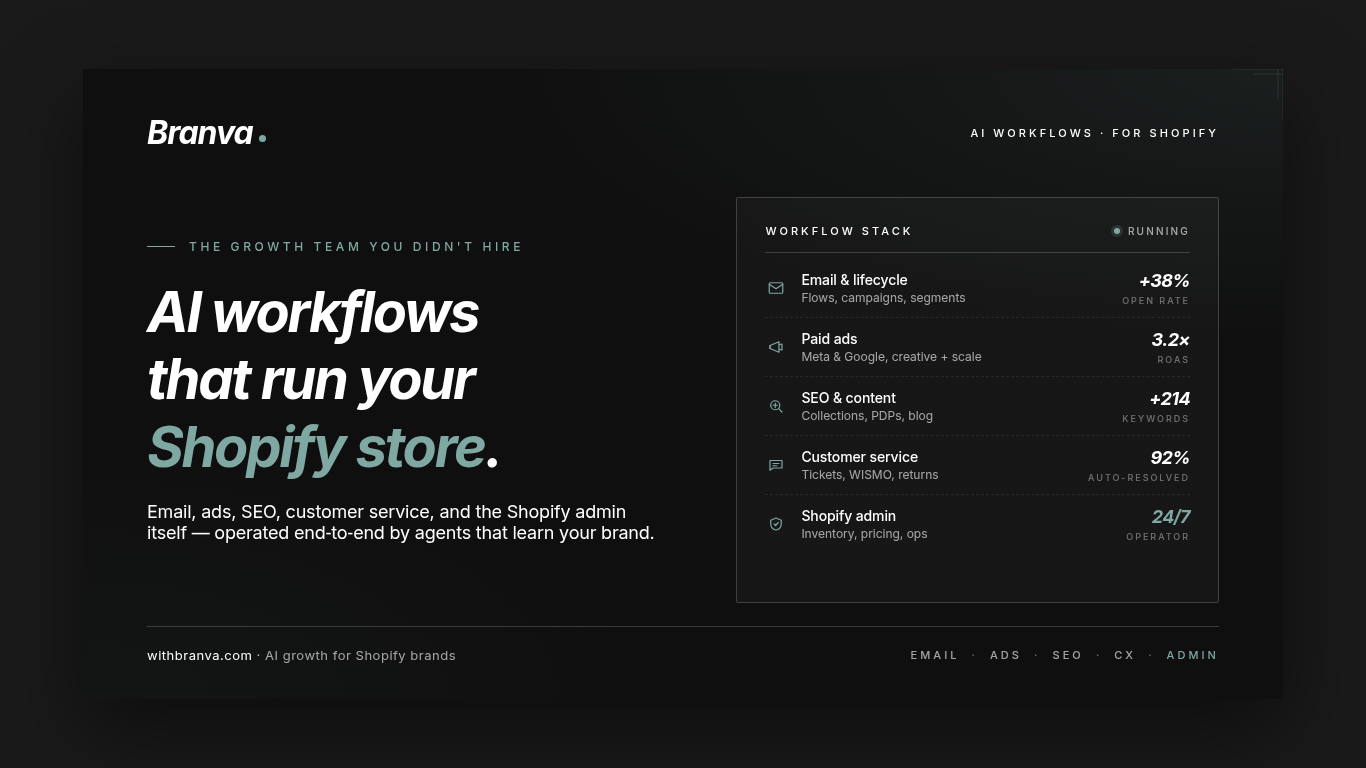
Most writing about AI and ecommerce is a list of things AI could theoretically do. This is the opposite: the jobs we actually hand Claude across client Shopify accounts, the ones we deliberately don't, and where each workflow is written up in full.
The pattern that emerged after doing this for a while is simple. Claude is good at the repeated, rule-bound, judgement-light work that humans do badly because they get bored or emotional. It is bad at deciding what the business should say. Almost every success and every failure we have had maps onto that line.
Table of Contents
- The dividing line
- Email and lifecycle
- Paid acquisition
- SEO and content
- Product pages and merchandising
- Store data and reporting
- The four we keep human
- Where to start
Key Takeaways
| Area | What Claude does | What stays human |
|---|---|---|
| Flow audits, segment logic, subject-line variants | The offer, and whether the brand would say it | |
| Paid | Stage classification, budget rules, delivery diagnosis | Creative direction and angle selection |
| SEO | Keyword clustering, brief building, technical audits | What we have evidence to claim |
| Product pages | Description drafts at scale, schema, alt text | Positioning and price |
| Store data | Multi-step analysis across orders, products, inventory | Deciding what to do about it |
The dividing line
Before the specifics, the rule we use to decide whether a job goes to Claude at all:
Can you write down what a correct answer looks like? If yes, it is a candidate. "Increase this ad set's budget by 10% if it beat target CPA" has a correct answer. "Is this the right brand voice for a returns email" does not — it has a judgement, and judgement is where models produce confident, plausible, wrong output.
The second test: what does being wrong cost? A wrong budget nudge costs 10% of one ad set for a day. A wrong claim in a product description is a refund and possibly a regulator. We automate the first category aggressively and the second category not at all.
Email and lifecycle
The highest-leverage place to start, because email work is unusually rule-bound.
Flow and account audits. Point Claude at a Klaviyo account and it will find the flows that are off, the segments that overlap, and the sends that are cannibalising each other. This is genuinely tedious for a human and mechanical for a model — the full method with prompts is in how to use Claude to analyse your Klaviyo account.
Segment logic. Translating "customers who bought twice but not in 90 days, excluding wholesale" into working segment conditions is exactly the kind of precise, boring transformation to hand over.
Variants, not voice. Subject lines, preview text, and structural variants for testing — yes. The decision about what the email is for, and whether your brand would actually say it — no. Getting a model to sound like your brand at all is its own problem, covered in making Claude sound like your brand.
Paid acquisition
The area where the human-versus-machine line is sharpest, because account management is mostly a small number of repeated decisions that people make emotionally.
The daily and weekly passes. Classify ad sets by stage, apply the budget rule, decide what gets promoted. The failure mode of a human running this is the ad they like and the test they want to work. A model does not have favourites. All four prompts are in running your Meta ads structure with Claude, and the structure they operate on is in Meta ads campaign structure in 2026.
Delivery diagnosis before creative blame. When something underperforms, working through delivery, click, destination and structure before concluding the creative is bad. We learned the value of this the expensive way — the $400 landing-page teardown is what happens when you skip it.
Not creative direction. What the ad should argue is the highest-value decision in the account and the one least suited to a model. Claude can produce fifty variations of an angle you chose. Choosing the angle is the job.
Tracking setup. Wiring Pixel, Conversions API and UTMs so the numbers agree — see connecting Meta ads to Shopify with Claude and the Meta Ads CLI connection.
SEO and content
Clustering and briefs. Grouping hundreds of queries into topics, spotting cannibalisation between existing pages, and turning a cluster into a brief. Mechanical, high volume, easy to check. The loop is in how to use Claude to run SEO for Shopify.
Technical audits. Crawling for the boring structural faults — thin titles, missing canonicals, orphan pages — and telling you which ones actually matter. We run a free Shopify SEO audit with Ahrefs and Claude this way.
Not "write me 50 blog posts." This is the one we feel strongly about. Publishing volume without anything original in it is precisely what Google's scaled content abuse policy exists to catch, and the policy is method-agnostic — it does not care whether a human or a model produced the pages. Our own rule is that no post ships unless it contains at least one thing that exists nowhere else: a measurement from our accounts, a workflow we actually run, or a first-person result with receipts. It is enforced by our build, not by good intentions.
Claude is excellent at structuring a post around evidence you have. It cannot supply the evidence.
Product pages and merchandising
Descriptions at scale. Hundreds of products with thin or manufacturer-copied copy is a genuine catalogue problem and a good fit — the method is in writing product descriptions with Claude for Shopify SEO.
Structured data and alt text. Mechanical, high volume, directly useful.
Image and photo prompts. Covered in Claude prompts for Shopify product photos.
Not claims. Anything about what the product does, what it is made of, or what it will achieve for the buyer gets human sign-off. A hallucinated material or benefit is a refund at best.
Store data and reporting
This is the part most people miss, because they think of Claude as a writing tool.
Connected to Shopify, it can query the store directly — orders, products, inventory, customers — which turns a class of questions from "export three CSVs and build a pivot table" into one prompt. "Which products lost conversion rate month over month, and what do they have in common?" is a real question you can now just ask.
Setup is in connecting Shopify to Claude Code and what the Shopify connector can do. If you are choosing between tools first, the Shopify AI toolkit covers when to use Claude Code versus an editor.
Start read-only. Give write access when you have a reason to, not by default.
The four we keep human
Being specific about this matters more than the list of what to automate.
1. The offer. What you sell, at what price, with what guarantee. Every marketing channel amplifies this and none of them fix it. If cold traffic does not convert, no workflow above will help.
2. Creative direction. The argument an ad makes. Models are good at variations on a chosen angle and poor at choosing which angle is true for your brand.
3. Anything that becomes a claim. Product properties, results, comparisons with named competitors. The cost of being wrong is not a bad metric, it is a refund, a chargeback or a regulator.
4. The final read on anything customer-facing. Not because output is usually bad, but because when it is wrong it is confidently wrong, and that is the failure mode that ships.
Where to start
If you are running a Shopify store and want one thing rather than a programme:
Start with the email audit. It is bounded, the correct answer is checkable, nothing goes live without you approving it, and the findings are usually worth real money in the first sitting. The Klaviyo analysis workflow is the whole thing.
Then connect the store, read-only. Setup here. Ask it questions you would otherwise export a CSV for. That is where the shift from "AI writes things" to "AI does work" actually happens.
Then the paid passes, if you are spending enough that daily decisions matter — the four prompts.
Do not start by generating content. It is the most tempting application, the easiest to do badly, and the one with a Google policy pointed directly at it.
This is what we run for clients as a managed service rather than a tool you operate — see what that looks like across a quarter, or book a strategy call.