How Do I Make My First $100,000 in MRR on Shopify?
The $50K → $100K MRR transition is when a Shopify store stops being a marketing project and starts being a real brand. Acquisition still matters; retention starts mattering more. Ops sophistication separates the brands that compound from the brands that plateau. Part of our Growth Ops pillar; previous: first $50K MRR.
The customer pain point
The brand hits $50K MRR cleanly. Meta + Google + Klaviyo are all paying. CS is systematized. SEO is starting to contribute. Everything is working — and yet the next 30-50% feels strangely hard. CAC creeps up. Ad accounts plateau no matter how much creative volume hits them. Repeat purchases level off. The founder starts hearing themselves say "we just need more traffic" and intuitively knows that's not the answer.
The reason: at $50K MRR most brands have maxed out the generic acquisition + retention playbook. The next leap requires investments most Shopify operators don't think to make until they're stuck.
Table of Contents
- Where you are at $50K–$100K MRR
- What you've earned the right to do now
- The investment shifts at this stage
- Realistic budget
- Honest timeline
- The single biggest leak
- What comes next (the 7-figure transition)
Key Takeaways
| Question | Answer |
|---|---|
| What changes between $50K and $100K? | Acquisition stops being the primary lever. Retention + brand defensibility take over. |
| Channel stack | Same 6 as $50K — but each one runs deeper, with stronger systems underneath. |
| Realistic budget | $15K–$40K/mo ads + ~$1K–$3K tools + meaningful team or full ops layer. |
| Timeline | 12–24 months from $50K. Brands that fix the brand layer hit the low end. |
| Biggest leak | Treating $100K as $50K with more ad spend. Doesn't work — the playbook has to change. |
| The hidden lever | Retention math. A brand with 40% 90-day repeat rate has 2x the effective LTV of one at 20%. |
The non-negotiable: the playbook that got you to $50K won't get you to $100K. Add brand defensibility, deepen retention, and stop trying to muscle through the plateau with more ad spend.
Where you are at $50K–$100K MRR
The honest definition:
- $50K MRR sustained for 3+ months with a healthy channel mix (no single channel >60%)
- Repeat purchase rate >25% within 90 days
- Multiple SKUs contributing (not 80% of revenue from one product)
- Brand recognition starting — branded search volume picking up
- Ops are systematized; the founder isn't personally bottlenecking day-to-day execution
- CAC is creeping up, ROAS is holding but compressing
At $80 AOV, $100K MRR = 1,250 orders/month. At $50 AOV, 2,000 orders. That's 50-70 orders/day, the volume where the brand has to operate like a system not a project.
What you've earned the right to do now
You've earned the right to:
- Invest in brand assets that pay back over 12-24 months (PR, partnerships, content brand, podcast/show)
- Build defensible retention mechanisms (community, loyalty program, subscription tier if applicable)
- Operate at meaningful organic media scale (consistent video, owned social, original research/data)
- Run the full retention stack: email + SMS + paid retargeting + post-purchase + win-back + replenishment
- Have a real CMO or strategic ops lead (in-house, fractional, or via a sophisticated done-for-you partner)
- Build proprietary data assets (zero-party data collection, segment-level reporting, LTV cohorts)
You have NOT yet earned the right to:
- Build a full in-house team across every channel (the unit economics work for a small senior team + outsourced execution, not for a 20-person marketing org)
- Make every channel a brand-focused channel (paid still needs to perform on direct response math)
- Stop tracking unit economics monthly (CAC creep at this stage is a leading indicator of trouble)
The investment shifts at this stage
Six shifts that separate brands that compound from $50K to $100K from brands that plateau:
1. Retention math becomes the primary lever
A brand at $50K MRR with 25% repeat rate at $80 AOV grows differently than one with 40% repeat rate. The math: at 25%, your effective LTV is ~$100; at 40%, ~$130. You can profitably pay 30% more per acquired customer. That's how brands break $100K without compressing margin.
Investments: post-purchase flows, replenishment flows (if applicable), win-back at 60/90/180 days, loyalty program, subscription tier for the categories that support one.
2. Brand becomes defensible asset, not optional polish
At $50K, "brand" is mostly visual identity + voice consistency. At $100K, brand becomes the thing that determines whether customers seek you out vs. you having to pay to find them. Branded search volume, organic social mentions, press, partnerships — these are the leading indicators of brand defensibility.
Investments: PR / earned media, partnerships, content with point of view (not just keyword-driven posts), founder-led social, original research.
3. Owned media scales meaningfully
At $50K you publish 4 posts a month and post on social. At $100K you're publishing consistent video (2-4 videos/week), maintaining a sub-stack-style email beyond promotional sends, possibly podcasting or running a show in your category. The owned media layer becomes a real acquisition channel.
4. Retention paid (not just acquisition paid)
Most Shopify brands at $50K run paid retargeting incidentally. At $100K it's a deliberate channel: paid social to existing customers with new-product launches, win-back campaigns, lifecycle-stage-specific creative. Spend split shifts toward retargeting being 25-35% of paid budget (vs 10-15% at the $50K stage).
5. Ops sophistication compounds
The brands that hit $100K cleanly have documented playbooks for every recurring workflow — sale launches, new product onboarding, returns processing, weekly reporting cadence. The Brand Brain layer (canon + live, queryable from every tool) is the structural answer.
Brands without this layer hit complexity ceilings — the founder becomes the bottleneck again, this time on judgment calls rather than execution.
6. Margin discipline starts mattering
At $50K most brands aren't deeply analyzing margin by SKU, by channel, by cohort. At $100K they have to. Channel-level profitability (not just ROAS), per-SKU contribution margin, cohort LTV by acquisition source. The numbers exist; the question is whether anyone's looking at them weekly.
Realistic budget
Total monthly cost: $16K–$45K depending on aggressiveness:
| Line item | Cost |
|---|---|
| Shopify (Shopify or Advanced) | $79–$299 |
| Klaviyo (15K–50K contacts) | $400–$1,500 |
| SMS platform (Attentive/Postscript) | $200–$1,000 |
| Helpdesk (Gorgias paid tier) | $200–$600 |
| Reviews app (Junip/Stamped) | $50–$300 |
| Subscription app (if applicable) | $50–$500 |
| Meta ads | $8,000–$25,000 |
| Google ads | $4,000–$12,000 |
| TikTok / other channels | $2,000–$5,000 |
| Content / creative production | $1,500–$4,000 |
| Strategic ops (in-house, fractional, or service) | $3,000–$10,000 |
| Total | ~$20,000–$50,000+ |
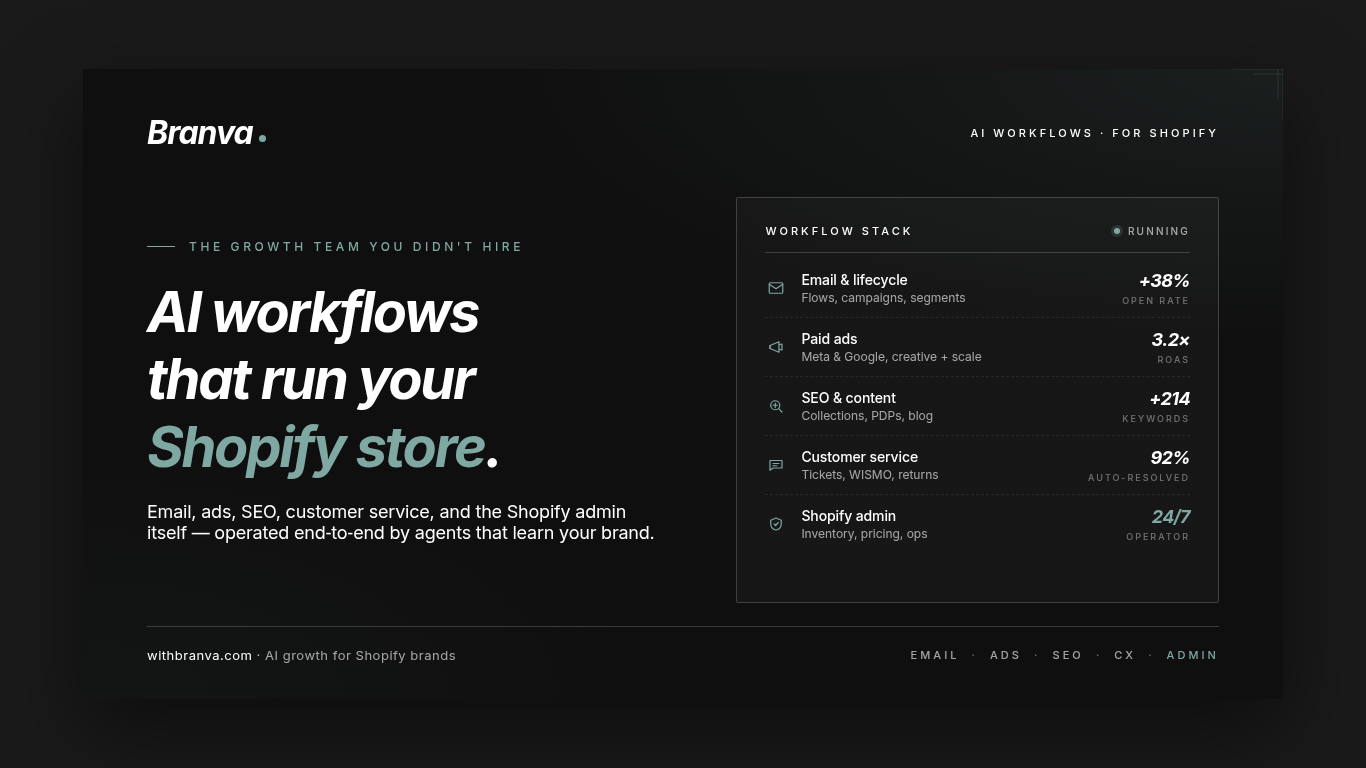
Branva's full ops layer fits in cleanly as the "strategic ops" line — done-for-you execution across paid, email, CS, SEO, and Shopify admin. The brand layer (PR, partnerships, founder voice) typically stays in-house or with a specialist.
Honest timeline
For brands at $50K with healthy unit economics and the discipline to invest in brand + retention:
- $50K → $65K: 3–6 months (deepen retention, add SMS, scale Meta + Google)
- $65K → $80K: 4–8 months (brand investments start contributing, repeat rate climbs)
- $80K → $100K: 5–10 months (the slowest stretch — this is where most brands stall)
Total: 12–24 months. Brands that started building brand + retention at $30-50K hit the low end. Brands trying to muscle through with more ad spend hit the high end or plateau.
The single biggest leak
Treating $100K MRR as $50K MRR with more ad spend. Most brands stuck between $50-80K share the same diagnosis:
- Same channel mix as $50K
- Same creative cadence
- Same retention stack (often just the 4 Klaviyo flows from $10K)
- Same brand investment (none)
- More ad spend trying to muscle the curve
The math doesn't work. At $50K MRR your effective CAC ceiling is, say, $40 (at $80 AOV with healthy first-purchase margin). To get to $100K MRR at the same unit economics you need 2x the qualified traffic at the same CAC. But CACs rise as you scale paid — so you actually need ~2.5x the traffic, paying CACs that compress margin.
The escape: make each customer worth more (retention) and reduce the share of acquisition that has to come from paid (brand + organic). Brands that get this leap right are spending similar absolute dollars on paid at $100K as they were at $60K — the growth came from the other levers.
What comes next (the 7-figure transition)
Past $100K MRR the playbook shifts again. The next stage is the $100K → $250K stretch, where:
- Team structure starts mattering (you're hiring senior individual contributors, not just operators)
- Brand becomes the primary acquisition channel for the top of the funnel (not paid)
- Channel diversification matters more (no single channel >50% of revenue)
- The brand becomes acquisition-worthy itself — investors, strategic partnerships, possibly acquirer interest
The MRR ladder series ends here for now — past $100K MRR the playbook diverges meaningfully by category. We'll publish that next-stage post when we have enough client data to write it properly.
Talk to Branva
The $50K-$100K transition is exactly where done-for-you ops + a real Brand Brain compound the hardest. Book a free working session and we'll audit your current ops layer, retention math, and channel mix live on the call. You walk away with a real diagnosis even if you don't work with us.
Frequently Asked Questions
Do I need a CMO at this stage?
If you can hire someone who's operated a $100K-$1M Shopify brand and earned the playbooks, yes. If you can't, a fractional CMO + strong ops execution layer (in-house or done-for-you) outperforms an inexperienced full-time hire.
How much of revenue should retention drive at $100K?
For mature brands at this stage: 35-50% of revenue from repeat customers, 50-65% from new. Brands above 50% repeat are subscription-shaped; brands below 30% are still acquisition-dependent and will plateau.
What about international expansion?
Underrated lever at $50K-$100K. If your category travels well (most CPG, beauty, accessories), opening one secondary market via Shopify Markets adds 10-30% revenue without doubling ad spend.
When should I hire vs. outsource the strategic layer?
If your category has 5-10 specific tactical playbooks that work and you can hire someone who's run them: hire. If the work is more cross-functional (paid + email + CS + SEO + ops in coordination), a senior outsourced partner like Branva outperforms a generalist hire.
Is profitability or growth the right focus at this stage?
Both, but ratios matter. A brand growing 8-12% month-over-month with healthy contribution margin is in a better long-term position than one growing 25% with negative contribution margin. The "grow at any cost" era is over.
Related reading
- How Do I Make My First $50,000 in MRR on Shopify? — previous post.
- How Do I Make My First $10,000 in MRR on Shopify? — back to the $10K stage.
- Brand Brain — the canonical source of truth — the ops sophistication layer for this stage.
- Branva vs. freelancers vs. agency vs. DIY — picking the operating model that fits.
- Case study: Lina Lennox 100% sales growth + 30% CAC reduction — a real $50K→$100K transition.
- The Growth Ops pillar — the systems behind scaling Shopify brands.