The Complete Guide to AI Marketing for Shopify Stores in 2026
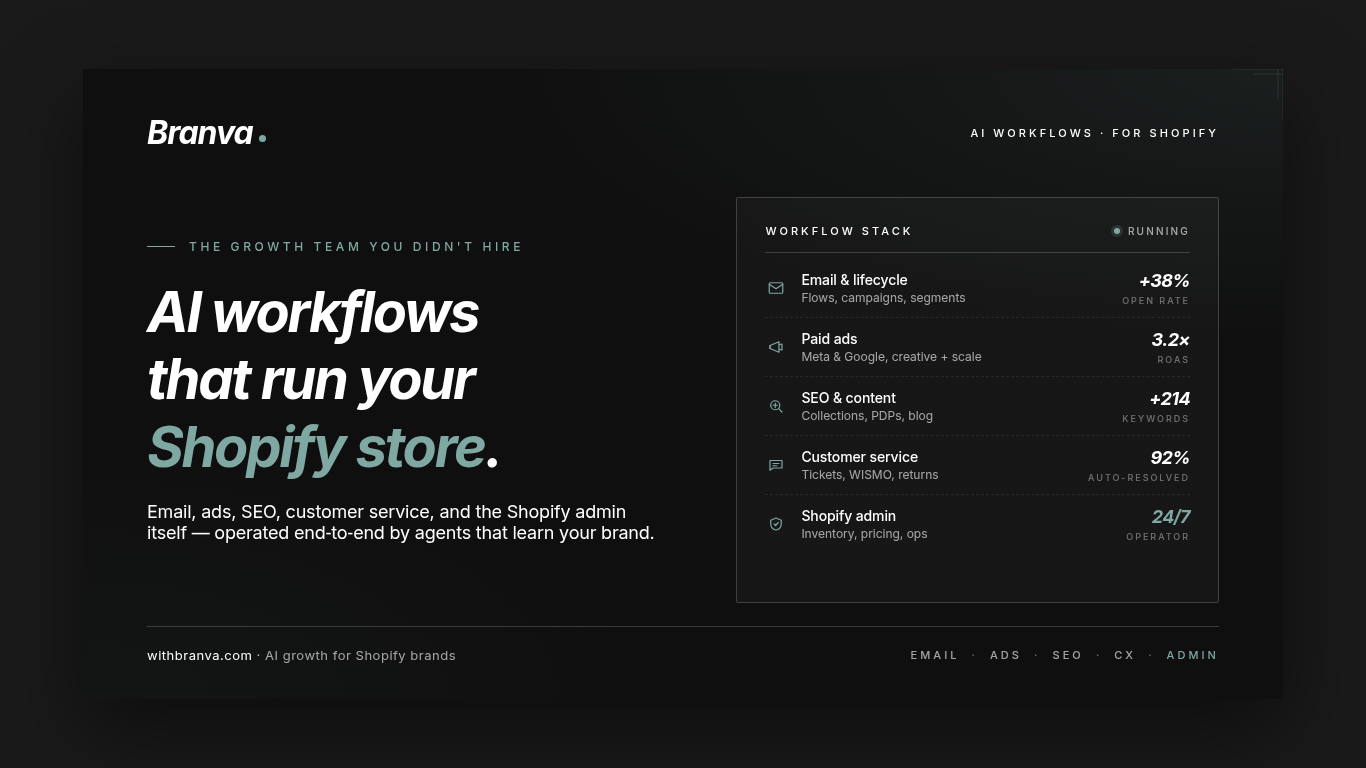
If you run a Shopify store in 2026, you've probably heard the phrase "AI marketing" thrown around a lot. But what does it actually mean for your business — and more importantly, what does it mean for your revenue?
AI marketing for Shopify stores in 2026 is the use of AI to run and improve email, paid social, search, and analytics in one connected system—so execution scales without a full in-house team. This guide breaks it all down: what AI marketing is, how it works across every channel, what it costs, and how Shopify founders are using it to grow faster than they ever could with a traditional agency or a DIY approach.
For broader context on where ecommerce is headed, see our role of automation in ecommerce. For measurement that makes AI useful, pair this with ecommerce analytics explained.
Let's get into it.
Table of Contents
- What Is AI Marketing for Shopify Stores?
- Why 2026 Is the Tipping Point
- The Four Pillars of AI Shopify Marketing
- AI Marketing vs. Traditional Marketing: The Real Cost Difference
- What AI Marketing Doesn't Replace
- How to Get Started With AI Marketing for Your Shopify Store
- The Bottom Line
Key Takeaways
| Point | Details |
|---|---|
| AI marketing for Shopify | AI automates and optimizes email, paid ads, SEO, and personalization using data—so small teams compete with larger budgets. |
| Why 2026 | Tools, economics, and competition make AI-assisted marketing the default for serious Shopify brands—not an experiment. |
| Four pillars | Email, Meta/Google ads, SEO, and customer insights/personalization form the core stack when you want compounding growth. |
| Human + AI | AI excels at execution; humans still own brand voice, strategy, and relationships—combine both. |
What Is AI Marketing for Shopify Stores?
AI marketing for Shopify stores means using artificial intelligence—machine learning, natural language processing, predictive analytics—to automate, optimize, and scale your marketing activity.
For Shopify store owners, that means AI tools and workflows that handle things like:
- Writing and optimizing email flows
- Building and testing ad creative for Meta and Google
- Generating and optimizing SEO content
- Analyzing customer behavior and predicting what they'll buy next
- Personalizing the shopping experience in real time
The key word is automate. Tasks that used to take a marketing team days to complete can now be done in hours — or run continuously in the background without any manual input at all.
Why 2026 Is the Tipping Point
AI marketing isn't new. But 2026 is the year it stopped being an experiment and became the default for smart Shopify brands.
Here's why:
The tools got good enough. Early AI marketing tools were clunky and produced generic output. Today's tools — across email, ads, SEO, and analytics — produce results that match or outperform human-only workflows.
The cost gap became impossible to ignore. Traditional agencies charge $3,000–$8,000/mo because they're staffing humans to do things AI now handles faster. The brands that figured this out first are operating at a significant cost advantage.
The competition is using it. If your competitors are running AI-assisted campaigns and you're not, you're already behind. AI doesn't just save time — it compounds. The more data it has, the better it gets.
The Four Pillars of AI Shopify Marketing
1. Email Marketing
Email is still the highest-ROI channel for Shopify stores — averaging $42 back for every $1 spent. But most stores are leaving money on the table because their email setup is either non-existent or set-and-forget.
AI changes this in three ways:
Flow optimization. AI tools analyze open rates, click rates, and purchase behavior to continuously refine your automated sequences — welcome flows, abandoned cart, post-purchase, win-back. Instead of setting a flow once and hoping for the best, the sequence evolves based on what's actually working.
Subject line and copy generation. AI can generate and A/B test subject lines and body copy at a scale that would take a human copywriter weeks to produce. More tests = more data = better performance over time.
Segmentation. AI identifies behavioral patterns in your list that human analysis would miss — and uses those patterns to send the right message to the right segment at the right time.
What good looks like: A properly AI-assisted email program should be driving 30–40% of your monthly Shopify revenue. If it's not, there's money sitting on the table.
2. Paid Advertising (Meta and Google)
Running Meta ads manually in 2026 is like navigating with a paper map. The platform's algorithm is sophisticated enough that the brands winning are the ones feeding it the best creative and the clearest signals — and doing it consistently.
AI helps in three key areas:
Creative production. AI-assisted creative tools dramatically reduce the time it takes to produce ad variants. More variants = more testing = faster learning about what resonates with your audience.
Audience targeting. Meta's own AI does most of the heavy lifting on targeting now — but the inputs matter. AI tools that analyze your customer data and help structure campaigns give the algorithm better signals to work with.
Performance analysis. AI can monitor campaign performance continuously and flag when creative is fatiguing, when a new audience is outperforming, or when budget should be reallocated — without waiting for a weekly agency report.
What good looks like: Weekly creative testing, a clear feedback loop between what's working and what's being built next, and a cost per acquisition that trends down over time as the data compounds.
For channel context, see our complete guide to paid ads for ecommerce and 7 essential types of ecommerce ads.
3. SEO
SEO is the channel most Shopify founders deprioritize because it feels slow. But it's also the channel that pays you back forever — organic traffic doesn't stop when you turn off the budget.
AI has fundamentally changed what's possible with Shopify SEO:
Content at scale. AI can research, outline, and draft SEO blog content significantly faster than a human writer — making it economically viable for small brands to build a content library that drives consistent organic traffic.
On-page optimization. AI tools analyze your product pages, collection pages, and content against what's ranking and surface specific recommendations — title tags, meta descriptions, internal linking, schema markup.
Keyword clustering. Instead of targeting one keyword per page, AI tools identify semantic clusters — groups of related keywords — that help your content rank for dozens of variations rather than just one.
What good looks like: A growing library of optimized content that drives compounding organic traffic month over month — reducing your reliance on paid channels over time.
For SEO fundamentals in ecommerce, read role of SEO in ecommerce.
4. Customer Insights and Personalization
This is the layer most Shopify founders haven't tapped yet — and it's where AI creates the biggest competitive moat.
AI-powered analytics tools can:
- Predict which customers are at risk of churning before they do
- Identify your highest-LTV customer segments and help you acquire more of them
- Personalize product recommendations in real time based on browsing and purchase behavior
- Surface the messaging and offers most likely to convert different segments
As more of your marketing activity runs through AI, these insights compound — the more data the system has, the smarter every decision becomes.
AI Marketing vs. Traditional Marketing: The Real Cost Difference
Here's the honest math:
| Service | Traditional Agency | AI-Powered Agency |
|---|---|---|
| Email marketing | $1,000–$2,000/mo | Included |
| Meta ads management | $1,500–$3,000/mo | Included |
| SEO | $1,000–$2,500/mo | Included |
| Total | $3,500–$7,500/mo | Quoted up front |
The output difference? Minimal — and in many cases, AI-assisted delivery is faster because there's no account manager bottleneck, no approval chains, no waiting for a monthly report.
What AI Marketing Doesn't Replace
Let's be honest about the limits.
AI is exceptional at execution — generating, testing, optimizing. It's less good at the things that require genuine human judgment and brand intuition:
- Brand voice and positioning — knowing what your brand stands for and how it should sound
- Strategic pivots — recognizing when a whole channel or approach isn't working and knowing why
- Relationship building — the founder-to-customer connection that makes small brands special
The best AI marketing setups combine AI-powered execution with human strategic oversight. That's the model that wins in 2026.
How to Get Started With AI Marketing for Your Shopify Store
If you're starting from scratch, here's the order of operations:
Step 1 — Get your email foundations right. Set up your core flows in Klaviyo — welcome, abandoned cart, post-purchase. Even basic AI-assisted flows will outperform most manually written sequences.
Step 2 — Get your Meta ads structure right. Before you start spending, make sure your campaign structure is set up to give Meta's algorithm the best possible signals. A well-structured $1,000/mo campaign will outperform a poorly structured $5,000/mo one every time.
Step 3 — Start building your SEO content library. Pick 10–15 keywords your customers are searching and start producing content. It takes 3–6 months to gain traction but it compounds indefinitely.
Step 4 — Build your analytics foundation. Make sure you can see clearly what's working — email revenue contribution, cost per acquisition from ads, organic traffic growth. You can't optimize what you can't measure. Use how to set up Shopify analytics correctly as a checklist.
Step 5 — Consider an AI-powered agency. If you want all of the above running without having to manage it yourself, an AI-powered Shopify marketing agency like Branva gives you the full stack — email, ads, SEO — managed end-to-end for a flat monthly fee. For the consolidated playbook, see how to grow Shopify sales with all-in-one marketing.
The Bottom Line
AI marketing isn't a trend. It's a structural shift in how Shopify brands can grow — and in 2026, the gap between brands using it and brands that aren't is widening fast.
The good news: it's never been more accessible. Whether you're a first-time founder with a $10k/mo store or a scaling brand pushing $100k/mo, AI marketing for Shopify stores is now within reach — and the brands that get started earliest will compound the most.
Grow your store with Branva
Branva is an AI-powered Shopify marketing agency. We run email, Meta ads, and SEO for Shopify brands — fully managed, on transparent monthly pricing. Book a free call to see what we'd do for your store.
Frequently Asked Questions
What is AI marketing for Shopify stores in 2026?
AI marketing for Shopify stores in 2026 is the use of AI tools and workflows—across email, paid media, SEO, and analytics—to automate execution, run more tests, and personalize experiences using your store and campaign data. It is not one plugin; it is how you run the full marketing stack with AI in the loop.
How is AI marketing different from traditional Shopify marketing?
Traditional marketing often relies on manual creative production, weekly reporting, and fixed retainers. AI marketing emphasizes continuous optimization, faster creative and copy iteration, and data-driven segmentation—often at a lower total cost than a full-service agency.
What should a Shopify brand automate first with AI?
Most teams get the fastest return by fixing email automation (flows and segmentation), then structuring paid campaigns for algorithm-friendly signals, then building an SEO content cadence—while fixing analytics so every channel’s contribution is visible. If you want that drafted and published from one place, Tilly runs it as one loop — audit, build, approve, publish, measure — with every draft waiting for your yes.
Does AI replace Shopify store owners or marketers?
No. AI accelerates execution and testing; founders and marketers still set positioning, approve tone, and decide strategy. The strongest setups pair human judgment with AI-powered delivery.
Related reading
- Role of Automation in Ecommerce — Where automation fits your stack.
- Ecommerce Analytics Explained: Complete Practical Guide — Metrics that make AI decisions trustworthy.
- How to Grow Shopify Sales With All-in-One Marketing — One system for email, ads, and content.
- Shopify Marketing Automation — What to automate, what to approve, what to keep.