Superside Brand Brain Alternative: A DTC-Focused Brand Brain Service
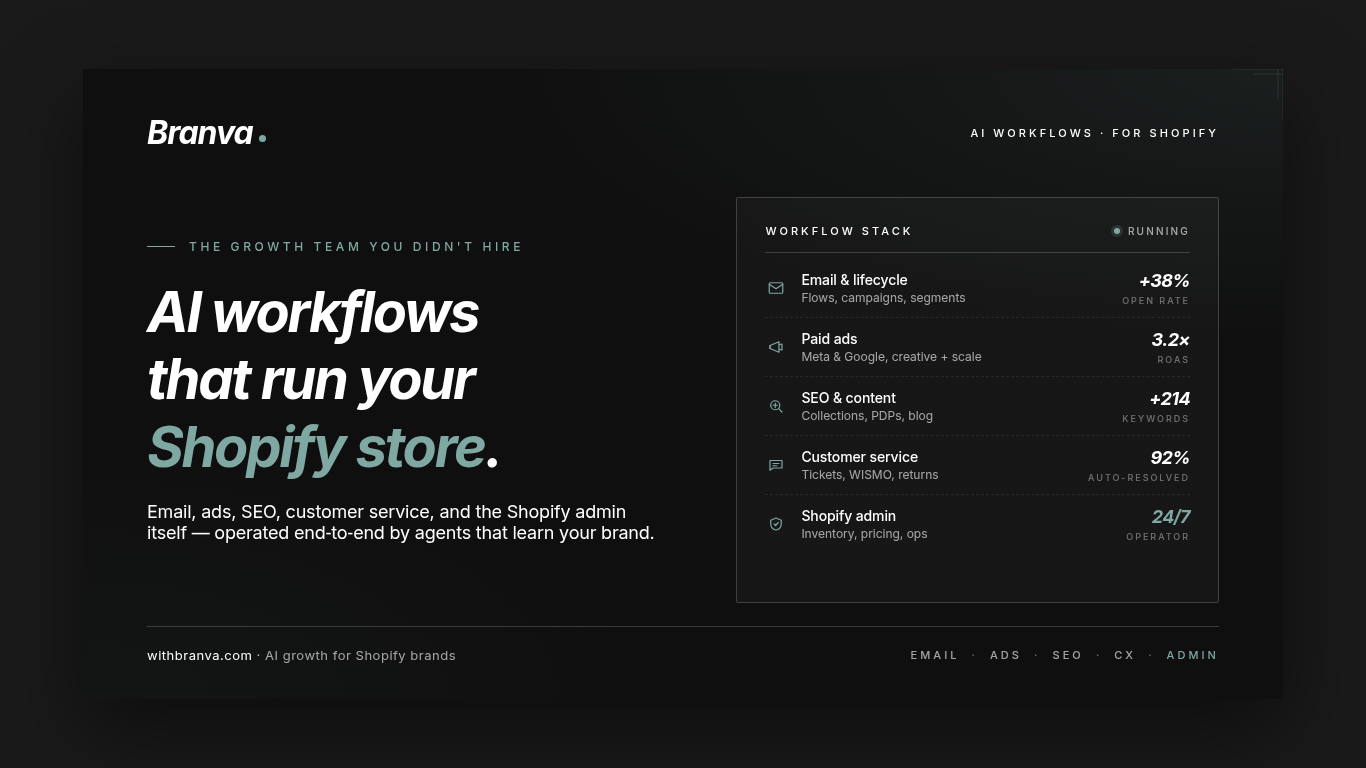
If you've researched "brand brain" services in 2026 you've probably found Superside. Their offering is well-built — and it's not the right shape for most Shopify / DTC brands. Here's the honest comparison and where Branva Brain fits instead. Part of our AI workflows pillar. For the product directly: Branva Brain.
The customer pain point
A Shopify founder doing $1-5M/year evaluates Superside's Brand Brain. The pitch resonates — one source of truth, your brand context in one place — but the engagement shape doesn't:
- Superside's pricing + scope assumes you're spending six figures a year on creative production
- The brain is positioned around creative ops — making sure designers and producers stay on-brand at scale
- The integration story is built for design tools (Figma, Frame.io, asset management)
- The buyer is usually a brand marketing director at a larger company
For DTC brands at $500K-$3M/year, that's a mismatch on every axis. You don't need an enterprise creative-ops solution. You need a brand brain that powers marketing execution — email flows, ad copy, CS replies, SEO posts, Shopify admin — across the AI tools your small team already uses.
That gap is where Branva Brain lives.
Table of Contents
- Quick honest comparison
- Superside Brand Brain — what it's built for
- Branva Brain — what it's built for
- The three real differences
- When Superside is still the right call
- How to switch (or start)
Quick honest comparison
| Superside Brand Brain | Branva Brain | |
|---|---|---|
| Built for | Enterprise / large brands, creative-ops scale | Shopify / DTC brands ($500K-$5M+/yr) |
| Primary use case | Keeping designers + producers on-brand at scale | Powering email, ads, CS, SEO, Shopify admin execution |
| Integration shape | Creative-tool ecosystem (design, asset mgmt) | AI tools + ops tools (Claude, ChatGPT, Klaviyo, Zendesk, Slack, Gmail, Drive) |
| Knowledge categories | Heavy on brand visuals, creative guidelines | Voice + products + CS policy + ops SOPs + edge cases |
| Cross-tool reach via MCP | Limited | Native (Claude, ChatGPT, Perplexity, Grok, Mistral, Cursor, Gemini) |
| Execution-attached | Brain describes; production handled separately | Brain runs alongside the team executing on it |
| Typical buyer | Brand marketing director at a 100+ person company | Shopify founder or ops lead at a 5–50 person brand |
The label is the same. The shape is different. Pick the one matched to how your brand actually runs.
Superside Brand Brain — what it's built for
Superside is a well-known creative-services platform — their model is on-demand design and creative production at enterprise scale. Their Brand Brain offering sits inside that worldview:
- The primary goal is brand consistency for creative output — making sure designers, video producers, motion artists, and marketing managers across a large organization deliver work that looks like the brand
- The integrations are weighted toward creative tooling (asset management, design platforms, brand templates)
- The pricing is built around the engagement shape they sell into — large brand teams with significant creative throughput
- The implementation typically runs through their professional services arm
If you're operating at that scale and your primary pain is "our 80-person marketing team produces inconsistent creative", Superside is genuinely a strong fit.
For most Shopify brands, that's a different problem set than the one you actually have.
Branva Brain — what it's built for
Branva Brain is positioned around the operational reality of a growing DTC brand:
- A small team (founder + 3-10 people) running marketing across email, paid ads, CS, SEO, and Shopify admin
- Multiple AI tools in daily use (Claude, ChatGPT, the Klaviyo flow drafter, sometimes Perplexity for research)
- Knowledge scattered across Slack threads, Gmail responses, Google Drive docs, and people's heads
- Voice + policies + product context + CS rules that need to land in every channel's output
The architecture:
- Canon layer — structured, curated, PII-free brand knowledge. Voice, products, policies, ops SOPs, edge cases.
- Live layer — synced from Slack, Gmail, Drive (and anything else you run) so the brain stays current without manual re-entry.
- MCP + REST — exposed to Claude, ChatGPT, Perplexity, Grok, Mistral, Cursor, Gemini and programmatic consumers like Klaviyo flows and custom apps.
- Execution-attached — built and maintained by the same team running your email, ads, CS, SEO operations. The brain doesn't just describe your brand; it does the work.
For the full picture see the Branva Brain product page.
The three real differences
Stripped of marketing language, three things actually distinguish the two:
1. What category of knowledge it's optimized for
Superside leans heavy on creative knowledge (visual identity, brand templates, motion guidelines). Branva Brain leans heavy on operational knowledge (voice + policies + CS edge cases + product context + SOPs).
Most DTC brands have decent creative guidelines (a Figma file is usually enough) but have a serious operational knowledge gap. Voice drift across channels, CS replies that sound off-brand, new hires who take 8 weeks to onboard. That's the gap Branva Brain fills.
2. Where the knowledge gets used
Superside's brain feeds creative production tools. Branva Brain's feeds AI tools and marketing execution platforms — including the ones DTC brands actually use every day.
If your team writes 50 Klaviyo campaigns, 200 ad variants, and 1,000 CS replies a month — versus, say, 20 hero creative pieces a quarter — the AI/execution-tool integration set matters way more than the creative-tool set.
3. Engagement shape
Superside is built for retainers that match enterprise creative ops volume. Branva Brain is built for DTC retainers that match marketing execution volume — at price points that work for a brand doing $500K/mo, not $5M/mo.
Bundled into a full Branva execution retainer the brain is free. Standalone, it's a much lighter setup + sync engagement than enterprise creative ops.
When Superside is still the right call
Honest cases where you should pick Superside:
- You're a 100+ person brand spending six figures+ annually on design and video production
- Your primary brand consistency pain is creative output, not marketing execution
- You already have strong operational documentation; the gap is design throughput
- Your buyers and reviewers sit in brand marketing org charts, not founder/ops org charts
For those companies, Superside is well-built and worth evaluating on its own merits.
For most growing Shopify and DTC brands, that's not the shape of the problem. The shape is "we run lean across email + ads + CS + SEO + Shopify admin, our brand context lives in seven places, and our AI tools sound generic." That's Branva Brain's lane.
How to switch (or start)
If you're evaluating Superside and the engagement shape feels too heavy:
- Book a 20-min working session at Branva — we map what your brain would hold and what it'd power
- Two-week canon build — Discovery → Build → Sync. Voice + FAQ + policies + SOPs + edge cases consolidated into one structured store
- Live layer connected — Slack, Gmail, Drive synced in their own tenancy
- MCP + REST endpoints provisioned — wired into Claude, ChatGPT, Klaviyo flows, anything you run
- Monthly sync retainer — a human keeps the canon clean and promotes good live signal as it shows up
If you're not currently using anything and asking "do I need a brain at all?" — that's the What Is a Brand Brain? post. Start there.
Related reading
- Branva Brain — the product page — features, architecture, what it powers.
- Brand Brain vs. Claude Projects & ChatGPT Memory — the AI-tool comparison.
- What is a Brand Brain? (And Why DTC Brands Need One) — the category explainer.
- Customer service using AI for Shopify: the brand-voice problem — how the brain shows up in CS specifically.
- The AI Workflows pillar — every workflow we run.