What to Look for in an AI Shopify Marketing Agency in 2026
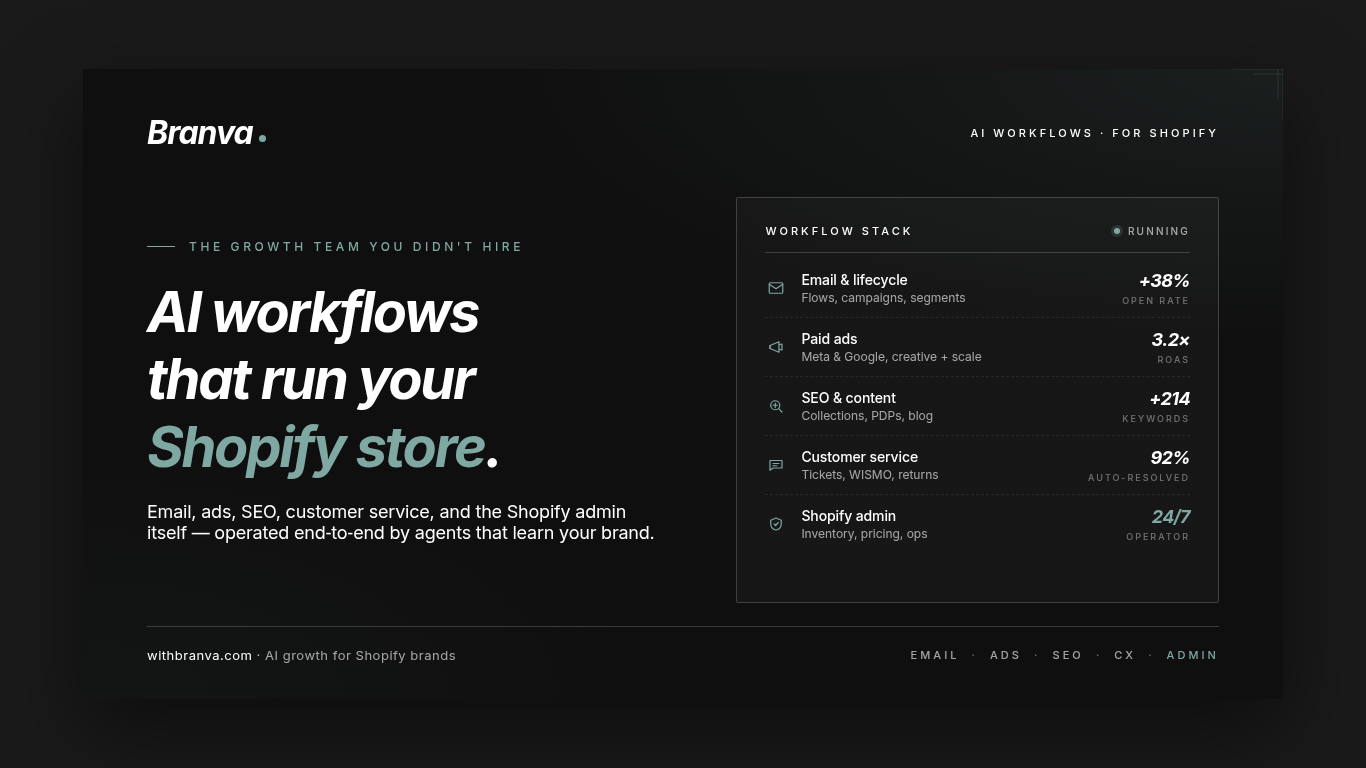
The term "AI marketing agency" is everywhere in 2026. Every agency with a ChatGPT subscription is slapping "AI-powered" on their website and charging the same $5,000/mo they always have.
So how do you tell the difference between an agency that's genuinely built on AI — and one that's just using the language?
This guide walks you through exactly what to look for, what questions to ask, and what red flags to watch out for when evaluating an AI Shopify marketing agency in 2026. For how we think about the full stack, start with the complete guide to AI marketing for Shopify stores in 2026; for proof in numbers, see our AI Shopify marketing agency case study.
Table of Contents
- Why the Right Agency Choice Matters More Than Ever
- 7 Things to Look for in an AI Shopify Marketing Agency
- Questions to Ask Before You Sign Anything
- Red Flags to Watch Out For
- The Bottom Line
Key Takeaways
| Point | Details |
|---|---|
| Filter for reality | Ask how AI shows up in email, ads, and SEO—not whether they "use AI." |
| Full-funnel coverage | Email + paid + SEO under one roof beats siloed vendors for Shopify growth. |
| Pricing should match efficiency | AI-native delivery usually costs less than legacy retainers—if savings vanished, ask where they went. |
| Proof & terms | Demand case studies with real revenue, weekly creative testing, and month-to-month contracts. |
Why the Right Agency Choice Matters More Than Ever
The agency market for Shopify brands has never been more crowded — or more confusing. You've got:
- Traditional agencies adding "AI" to their pitch decks without changing their process
- Freelancers using AI tools but lacking the strategic depth to drive real growth
- Genuinely AI-native agencies that have rebuilt their delivery around AI from the ground up
The difference in outcomes between these three categories is significant. An agency using AI as a genuine operational advantage can deliver faster, test more, and optimize better — all at a lower cost. An agency using "AI" as a marketing buzzword is just a traditional agency charging you for the same slow, expensive process.
Knowing which is which before you sign anything is worth the time. The right AI Shopify marketing agency in 2026 should line up with how you actually grow: retention (email), acquisition (paid), and compounding demand (SEO)—see how to grow Shopify sales with all-in-one marketing for why that coordination matters.
7 Things to Look for in an AI Shopify Marketing Agency
1. They Can Explain Exactly How AI Is Used in Their Delivery
This is the most important filter. Ask directly: "How does AI factor into how you actually do the work?"
A genuine AI-native agency will be able to walk you through their workflow in detail — what tools they use, which parts of the process are AI-assisted, and how that translates into faster or better output for your brand.
Vague answers like "we use AI to enhance our process" or "AI helps us work smarter" are red flags. That's marketing language, not operational reality.
What good looks like: A specific answer. "We use AI to generate and test email copy variants, to produce ad creative at scale, and to identify keyword opportunities for SEO — here's how each of those works in practice."
2. They Cover All Three Core Channels
Email. Paid ads. SEO. These three channels work together — and an agency that only handles one or two is leaving money on the table for you.
Email drives retention and repeat purchase. Paid ads drive acquisition. SEO drives compounding organic traffic. When all three are running and talking to each other, the effect is significantly greater than the sum of the parts.
An agency that only runs your ads doesn't know what your email program is doing. An agency that only does SEO isn't touching the channels driving 80% of your near-term revenue. You want one team with visibility across everything.
What good looks like: Full-channel coverage — email, paid, and SEO — managed by one team with a unified view of your performance.
3. Their Pricing Reflects the AI Efficiency Advantage
Here's a simple test: if an agency claims to use AI but is still charging $3,000–$5,000/mo for the same services, ask them where the efficiency savings are going.
AI doesn't just make agencies faster — it fundamentally reduces the cost of delivering good marketing work. An agency that has genuinely rebuilt around AI should be able to pass those savings on. If they're not, they're either not as AI-native as they claim, or they're keeping the margin for themselves.
Reasonable pricing for a genuine AI-powered full-service Shopify marketing agency in 2026 is significantly lower than traditional agency rates. Not because the quality is lower — but because the delivery model is more efficient.
What good looks like: Transparent, founder-friendly pricing that reflects the efficiency of AI delivery. Flat monthly fees, no hidden costs, no long-term lock-ins.
4. They Have a Real Testing Cadence for Ads
One of the biggest advantages of AI in paid advertising is speed of creative production and testing. An AI-native agency should be testing new creative variants every week — not every month.
Ask specifically: "How many creative variants do you produce and test per month? What does your testing cadence look like?"
Traditional agencies typically produce two or three new creative pieces per month. An AI-assisted creative workflow can produce ten to fifteen — which means dramatically faster learning about what resonates with your audience.
What good looks like: Weekly creative testing, a clear feedback loop between performance data and creative production, and a systematic approach to scaling winners and cutting losers fast.
For context on paid strategy, read complete guide to paid ads for ecommerce.
5. They Have Proof — Not Just Promises
Case studies. Real numbers. Specific outcomes.
Any agency worth working with should be able to show you concrete results from real clients — revenue growth, ROAS improvement, email revenue contribution, organic traffic growth. Not vague testimonials or percentage improvements without context.
Be particularly skeptical of agencies that are heavy on social proof ("Trusted by 500+ brands!") but light on specific outcomes. Volume of clients is not the same as quality of results.
What good looks like: Specific case studies with real numbers — starting revenue, ending revenue, timeframe, and a breakdown of what drove the growth.
6. They're Transparent About What AI Can and Can't Do
An honest AI-native agency will tell you what AI is genuinely great at — and where human judgment still matters.
AI is exceptional at execution: generating, testing, and optimizing content and creative at scale. It's less suited for brand positioning, strategic pivots, and the kind of creative intuition that makes a brand feel distinct.
An agency that claims AI handles everything with no human involvement is either overselling or underdelivering on the strategic side. The best model is AI-powered execution with human strategic oversight — fast delivery without sacrificing brand quality.
What good looks like: A clear explanation of where AI adds value in the delivery process, and where experienced humans are still making the calls.
7. They Work Month-to-Month
Long-term contracts in the agency world exist to protect the agency, not the client. If an agency is confident in their results, they don't need to lock you in for six or twelve months to make the relationship work.
Month-to-month agreements put the pressure where it belongs — on the agency to keep performing. If results aren't materializing, you should be able to leave without penalty.
What good looks like: Month-to-month terms, no setup fees, transparent pricing with no hidden costs.
Questions to Ask Before You Sign Anything
Here are the exact questions worth asking in any agency evaluation conversation:
- "Walk me through exactly how AI is used in your email, ads, and SEO delivery."
- "How many creative variants do you produce and test per month for ads?"
- "Can you show me a specific case study with real revenue numbers?"
- "What does your reporting look like — how do I know what's working?"
- "What's your contract structure — is this month-to-month?"
- "What happens in the first 30 days? What should I expect to see?"
How an agency answers these questions tells you more than their website ever will. Pair answers with your own measurement baseline—ecommerce analytics explained and Shopify analytics setup help you judge whether reporting is real.
Red Flags to Watch Out For
"We use AI to enhance our process." — Vague. Press for specifics.
Long-term contracts with significant early termination fees. — Protect yourself. Month-to-month is standard for confident agencies.
No real case studies with actual numbers. — Testimonials are nice. Revenue growth is evidence.
A focus on vanity metrics. — Impressions, reach, follower growth. These don't pay your Shopify bill. Revenue, ROAS, email revenue contribution, and organic traffic growth do.
Slow onboarding. — A genuinely AI-native agency should be able to get your email flows live and your ad campaigns restructured within two to three weeks. If the onboarding timeline is six to eight weeks, the "AI-powered" claim is probably more marketing than reality.
One-size-fits-all packages. — Your store is different from every other store on Shopify. An agency that doesn't take the time to understand your specific situation before proposing a solution is running a template business, not a growth partnership.
The Bottom Line
Choosing the right AI Shopify marketing agency in 2026 comes down to one question: can they show you the receipts?
Real results. Real process. Real pricing that reflects the efficiency of AI delivery.
The agencies worth working with will answer every question on this list without hesitation. The ones that can't — or won't — are the ones to avoid.
Talk to Branva
Branva is an AI-powered Shopify marketing agency. We run email, Meta ads, and SEO for Shopify brands — fully managed, month-to-month, on transparent monthly pricing. Book a free call and we'll answer every question on this list — and show you exactly what we'd do for your store.
Frequently Asked Questions
How do I choose an AI Shopify marketing agency in 2026?
Start with delivery: ask exactly how AI is used for email, ads, and SEO. Then confirm full-channel coverage, weekly ad testing, transparent pricing that reflects efficiency, case studies with real revenue, and month-to-month terms. If those pieces do not line up, keep looking.
What should an AI Shopify marketing agency cost in 2026?
Legacy full-service retainers often sit in the $3,000–$7,500/mo range. AI-native delivery should cost less—not because work is “cheap,” but because workflows are more efficient. Compare total fee to what is included (email + paid + SEO + reporting) and ask where efficiency shows up in the price.
Is “AI-powered” on a website enough proof?
No. Buzzwords are not a workflow. You want specifics: tools, testing cadence, how creative variants are produced, how SEO and email connect to paid, and how reporting ties to revenue.
Why does one team for email, ads, and SEO matter?
Silos hide waste: email and paid can fight for credit, SEO can target topics that do not match what converts in ads, and nobody owns the full funnel. One team with one view of performance fixes that—especially on Shopify.
Related reading
- The Complete Guide to AI Marketing for Shopify Stores in 2026 — Stack-level context before you hire.
- AI Shopify Marketing Agency Case Study: $18k to $51k/mo in 90 Days — What proof can look like.
- How to Grow Shopify Sales With All-in-One Marketing — Why coordinated channels beat point solutions.
- 7 Best Shopify Marketing Strategies for Rapid Store Growth — Tactics to compare against an agency’s plan.