AI vs Traditional Shopify Marketing — What's Actually Better for Your Brand in 2026
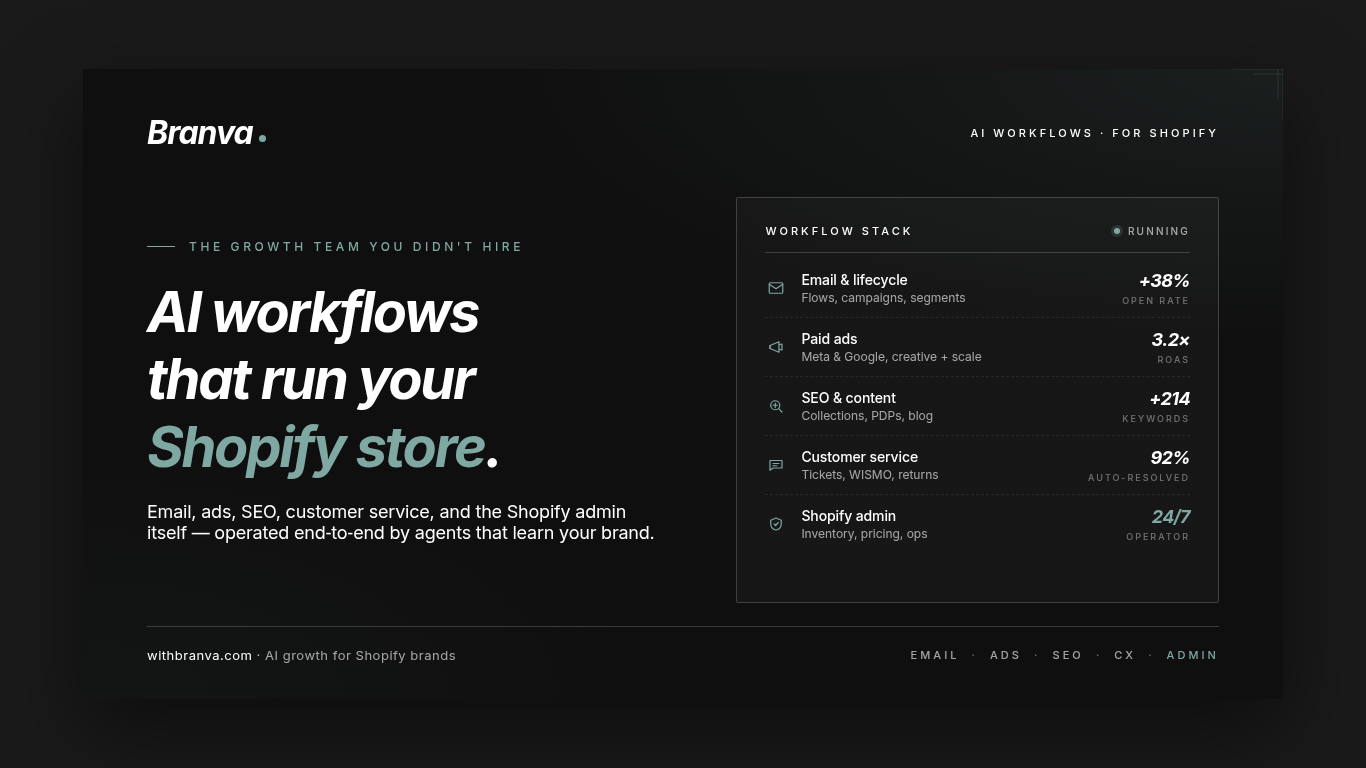
If you're trying to grow your Shopify store in 2026, you're facing a choice that didn't really exist three years ago: traditional marketing agency, or AI-powered marketing?
The honest answer isn't "AI always wins." It's more nuanced than that — and understanding the real differences will help you make a much better decision for your brand.
This post breaks down both approaches across every dimension that matters: speed, cost, quality, scalability, and fit for different stages of growth. For pricing context, read how much an AI Shopify marketing agency costs in 2026; for how to pick a partner, see what to look for in an AI Shopify marketing agency in 2026.
Table of Contents
- What We Mean by "Traditional" vs "AI-Powered"
- Speed: How Quickly Can You Expect Results?
- Cost: What Does Each Approach Actually Run?
- Quality: Is the Output Actually as Good?
- Scalability: What Happens as You Grow?
- Accountability: Who's Responsible for Results?
- Which Is Right for Your Brand?
- The Honest Summary
Key Takeaways
| Point | Details |
|---|---|
| Traditional | Human-driven delivery, heavier process—often slower and pricier full-service retainers. |
| AI-powered | Delivery rebuilt around AI for copy, creative, SEO, and analysis—faster tests, lower marginal cost. |
| Quality | AI wins on volume, consistency, and optimization speed; humans still lead brand nuance at scale. |
| Fit | Most $5k–$150k/mo Shopify brands align with AI-powered execution; $300k+/mo may add senior strategy. |
If you are choosing between models right now, AI vs a marketing agency vs freelancers puts the four options in one table, including where an agency is still the better buy.
What We Mean by "Traditional" vs "AI-Powered"
First, let's define terms — because these get blurry fast.
Traditional Shopify marketing refers to the conventional agency model: a team of human specialists (account managers, copywriters, paid media managers, SEO strategists) doing the work manually using standard tools. They might use some AI tools on the side, but the core delivery process is human-driven.
AI-powered Shopify marketing refers to an agency or system that has rebuilt its delivery layer around AI — using AI to generate creative, write and optimize copy, identify SEO opportunities, and analyze performance data at a scale and speed that human-only teams can't match.
The difference isn't just about tools. It's about how the work gets done, how fast it moves, and what it costs.
For the full-stack picture, see the complete guide to AI marketing for Shopify stores in 2026.
Speed: How Quickly Can You Expect Results?
Traditional Agency
Traditional agencies have process overhead built in. Briefings, approvals, revision rounds, account manager handoffs. A typical timeline looks like:
- Week 1–2: Onboarding and strategy
- Week 3–4: Brief development and creative production
- Week 5–6: Campaign setup and launch
- Week 7+: First real performance data
That's six to seven weeks before you have meaningful data to work with. For email flows specifically, the build-and-launch cycle at a traditional agency typically takes three to four weeks.
AI-Powered Agency
AI compresses every stage of this timeline. No brief-to-copy revision rounds because AI generates multiple variants simultaneously. No waiting for a creative team to have bandwidth because AI production runs continuously.
A genuine AI-native agency can typically:
- Have core email flows built and live within 10–14 days
- Have a restructured ad campaign running within one week
- Produce 10–15 creative variants for testing in the first two weeks
Verdict: AI-powered wins on speed. For Shopify brands where every month of slower growth has a real cost, this gap matters.
Cost: What Does Each Approach Actually Run?
Traditional Agency
Full-service traditional agency: $4,500–$12,000/mo depending on scope and agency size. Even a mid-tier traditional agency handling email, ads, and SEO is likely to run $3,000–$5,000/mo minimum.
Most of this is paying for human labor to do work that AI now handles.
AI-Powered Agency
Full-service AI-powered agency: $500–$1,000/mo for a legitimate operation covering all three core channels.
The efficiency of AI delivery fundamentally changes the economics — and the best AI-native agencies pass those savings on to clients rather than pocketing the margin.
Verdict: AI-powered wins on cost. For most Shopify brands at the $5k–$100k/mo revenue stage, the traditional agency price point is simply not justified by the ROI.
See the full breakdown in AI Shopify marketing agency cost in 2026.
Quality: Is the Output Actually as Good?
This is the question most founders ask — and it's the most nuanced answer.
Where AI-Powered Wins on Quality
Volume and variation. AI can produce ten ad creative variants in the time it takes a human creative to produce two. More variation = more testing = faster learning about what works. Over time, the AI-assisted approach almost always outperforms the traditional one on paid advertising performance simply because of the testing velocity.
Consistency. AI doesn't have off days, doesn't get distracted, and doesn't deprioritize your account when a larger client demands attention. The quality of execution is consistent week over week.
Optimization speed. AI can analyze performance data and surface insights faster than any human analyst. Email flows get optimized based on real-time behavior data. Ad campaigns get adjusted without waiting for a monthly review call.
Where Traditional Agencies Still Have an Edge
Brand nuance. An experienced human strategist who deeply understands your brand can make creative and strategic calls that an AI system would miss. Knowing when to break the rules, when a campaign needs to take a different tone, when the data is telling you something the data can't fully explain — these are areas where human judgment still adds real value.
Complex strategy. For brands at significant scale ($500k+/mo) navigating complex challenges — international expansion, major brand repositioning, multi-channel attribution at scale — the strategic depth of a senior agency team is harder to replicate with AI alone.
Creative direction. High-end visual creative — photography, video production, brand identity work — still benefits significantly from skilled human creative directors. AI assists here but doesn't replace great taste.
Verdict: Depends on your stage. For most Shopify brands at the $5k–$150k/mo range, AI-powered quality is sufficient and often superior for execution. For brands at significant scale with complex challenges, a hybrid of AI execution + senior human strategy makes more sense.
Scalability: What Happens as You Grow?
Traditional Agency
Scaling with a traditional agency typically means one thing: higher fees. More volume = more human hours = higher monthly retainer. As your brand grows, your agency cost grows proportionally — or you hit a ceiling where your account size doesn't justify the attention you need.
AI-Powered Agency
The scalability advantage of AI-powered delivery is that the marginal cost of doing more is significantly lower. More email campaigns, more ad variants, more SEO content — the AI infrastructure handles increased volume without a proportional increase in cost.
At Branva, your rate is agreed up front regardless of how many flows you need built, how many creative variants you want to test, or how much SEO content you want produced. The delivery model scales with your ambitions without the bill scaling with it.
Verdict: AI-powered wins on scalability at the growth stage most Shopify brands are navigating.
Accountability: Who's Responsible for Results?
This is an underrated part of the agency evaluation — and both models have real trade-offs.
Traditional Agency
Traditional agencies often have complex attribution models and lots of reasons why results are trending in the wrong direction. Long contract terms mean you're locked in even if performance is disappointing. The account manager changes and suddenly nobody remembers your brand strategy.
AI-Powered Agency
The best AI-native agencies operate month-to-month — because they're confident in their results and don't need a contract to retain clients. If the results aren't there, you leave. That puts the pressure exactly where it belongs.
Verdict: AI-powered wins on accountability when paired with month-to-month terms.
Which Is Right for Your Brand?
Use this as a quick guide:
AI-powered agency is the right fit if:
- You're doing $5k–$150k/mo on Shopify
- You're a first-time founder or small team without internal marketing resources
- You want full-channel coverage (email, ads, SEO) without managing multiple vendors
- Budget is a real consideration and you want the best value per dollar
- You want to move fast and see results within 30–60 days
Traditional agency might make sense if:
- You're doing $300k+/mo and need senior strategic depth
- You have complex multi-market or multi-brand needs
- You're running sophisticated brand campaigns that require high-end creative production
- Budget is not the primary constraint
DIY might make sense if:
- You're pre-revenue and genuinely can't afford any agency cost
- You have marketing skills in-house and primarily need tools, not a team
- You want to learn the channels yourself before delegating
For the vast majority of Shopify brands in 2026 — particularly first-time founders, product entrepreneurs, and businesses making the move to e-commerce — an AI-powered agency is the right call. Better speed, lower cost, and quality that matches or exceeds the traditional model for the channels that drive most of your revenue.
Proof in practice: AI Shopify marketing agency case study.
The Honest Summary
| Traditional Agency | AI-Powered Agency | |
|---|---|---|
| Speed | Slow (6–8 weeks to results) | Fast (2–3 weeks to results) |
| Cost | $3,000–$12,000/mo | $500–$1,000/mo |
| Creative volume | Low (2–3 variants/mo) | High (10–15 variants/mo) |
| Multi-channel | Often siloed | Integrated by default |
| Contract | 6–12 months typical | Month-to-month |
| Best for | $300k+/mo brands | $5k–$150k/mo brands |
In 2026, for most Shopify founders, the choice is increasingly clear. AI vs traditional Shopify marketing is not a religion—it is a fit question. AI-powered marketing delivers the output that matters — faster, cheaper, and with a level of testing velocity that traditional agencies simply can't match—for the stage where most brands live.
Talk to Branva
Branva is an AI-powered Shopify marketing agency. We run email, Meta ads, and SEO for Shopify brands — fully managed, no contracts, transparent monthly pricing. Book a free call and we'll show you exactly what we'd do for your store.
Frequently Asked Questions
AI vs traditional Shopify marketing in 2026—which wins?
There is no universal winner. Traditional fits heavy strategy, multi-market complexity, and premium creative at high revenue. AI-powered fits most $5k–$150k/mo brands that need speed, integrated channels, and weekly testing without a $5k+ retainer.
Is AI marketing lower quality than traditional?
Not for execution: email flows, ad variants, SEO cadence, and reporting often improve with higher testing volume and consistent optimization. Brand nuance and repositioning at scale still benefit from senior humans—often in a hybrid model.
Can I use AI tools in-house instead of an agency?
Yes, if you have time to coordinate email, paid, and SEO and to interpret performance. Many founders use an AI-powered agency to get one team and one reporting loop—see how to grow Shopify sales with all-in-one marketing.
How do I measure either model fairly?
Track email revenue share, paid ROAS, organic sessions, and CAC trend—with clean analytics (Shopify analytics setup, ecommerce analytics explained). Compare models on the same metrics, not vanity reach.
Related reading
- How Much Does an AI Shopify Marketing Agency Actually Cost in 2026? — Numbers behind both models.
- What to Look for in an AI Shopify Marketing Agency in 2026 — How to vet providers.
- The Complete Guide to AI Marketing for Shopify Stores in 2026 — What “AI-powered” should include.
- Complete Guide to Paid Ads for Ecommerce — Why creative testing velocity matters.