Complete Guide to Competitive Advantage in Ecommerce
Most American ecommerce businesses face intense pressure to stand out in a crowded marketplace. With over 90 percent of shoppers expecting unique value and seamless experiences, the difference between success and failure can be razor thin. For actionable tactics, see our 7 best Shopify marketing strategies and Shopify store marketing guide. Building a real competitive advantage in ecommerce means more than just having great products or low prices. This guide uncovers the strategies and competitive e commerce insights that help American brands gain an edge and thrive online.
Table of Contents
- Defining Competitive Advantage In Ecommerce
- Major Sources Of Ecommerce Differentiation
- Technology And Tools Shaping Ecommerce Advantage
- Building Sustainable Strategies For Growth
- Common Mistakes That Undermine Competitiveness
Key Takeaways
| Point | Details |
|---|---|
| Understanding Competitive Advantage | Ecommerce businesses must identify unique strengths and leverage them for superior performance in a dynamic market. |
| Key Sources of Differentiation | Successful differentiation relies on cost leadership, quality, and exceptional customer experiences that create real value. |
| Role of Technology | Strategic implementation of technology is crucial for enhancing competitive capabilities and engaging customers effectively. |
| Avoiding Common Pitfalls | Businesses should prioritize transparency and customer relationship management to maintain trust and competitiveness. |
Defining Competitive Advantage In Ecommerce
Competitive advantage represents the strategic capability that allows an ecommerce business to outperform its competitors and create exceptional value for customers. According to Wikipedia, competitive advantage refers to the attributes and resources that enable a firm to achieve superior performance in its market segment. In the dynamic world of online commerce, this concept goes beyond traditional business strategies and demands innovative approaches to standing out.
At its core, competitive advantage involves identifying and leveraging unique strengths that differentiate your ecommerce brand from others. Research from academic journals suggests that achieving this advantage requires a multifaceted approach focused on key strategic elements. As documented in recent studies Journals, businesses can develop competitive advantage through several critical pathways:
- Cost Leadership: Offering products or services at lower prices than competitors
- Product Differentiation: Creating unique product features or experiences
- Customer Service Excellence: Providing exceptional support and engagement
- Technology Innovation: Implementing cutting-edge technological solutions
- Personalization: Tailoring experiences to individual customer preferences
Successful ecommerce brands understand that competitive advantage is not a static concept but a continuous process of adaptation and improvement. Businesses must constantly analyze their market, understand customer needs, and develop strategies that create genuine value. The most effective approaches combine multiple advantages rather than relying on a single strategic dimension. By integrating technological capabilities, customer insights, and innovative business models, ecommerce companies can build sustainable competitive advantages that drive long-term growth and customer loyalty.
Major Sources Of Ecommerce Differentiation
Ecommerce differentiation represents the strategic approach businesses use to distinguish themselves in a crowded digital marketplace. According to Journals, key sources of differentiation include cost leadership, quality, flexibility, and delivery mechanisms that create unique value propositions for customers.
The resource-based view of business strategy provides critical insights into how companies can develop sustainable competitive edges. As explained by Wikipedia, organizations achieve meaningful differentiation by leveraging unique internal resources that are challenging for competitors to replicate. These distinctive capabilities might include:
- Proprietary Technologies: Developing innovative platforms or tools
- Brand Reputation: Building strong, trustworthy customer relationships
- Customer Experience: Creating seamless, personalized shopping journeys
- Data Analytics: Utilizing advanced insights for targeted marketing
- Supply Chain Optimization: Implementing efficient, responsive logistics
Successful ecommerce businesses understand that differentiation is not about being different for its own sake, but about creating genuine value that resonates with target customers. By strategically combining technological innovation, customer understanding, and unique operational capabilities, companies can develop compelling advantages that set them apart in the competitive digital marketplace.
 The most effective differentiation strategies are dynamic, continuously evolving to meet changing customer expectations and technological advancements.
Technology And Tools Shaping Ecommerce Advantage
Technology has become the cornerstone of competitive advantage in modern ecommerce, fundamentally transforming how businesses engage with customers and manage their operations. According to research from arXiv, strategic implementation of information technology applications can significantly enhance a company's competitive capabilities by improving efficiency, customer engagement, and overall business processes.
The technological ecosystem of ecommerce encompasses a wide range of innovative tools and platforms that enable businesses to create unique value propositions. As documented in recent academic studies Journals, emerging technologies are reshaping traditional business models and demanding a comprehensive reassessment of competitive strategies. Key technological drivers include:
- Cloud Computing: Enabling scalable, flexible infrastructure
- Artificial Intelligence: Powering personalized customer experiences
- Machine Learning: Generating predictive analytics and insights
- Advanced Payment Systems: Creating seamless transaction experiences
- Integrated Marketing Platforms: Delivering omnichannel engagement
Successful ecommerce businesses recognize that technological advantage is not about adopting every new tool, but strategically selecting and integrating technologies that align with specific business goals and customer needs. By thoughtfully leveraging these advanced technological capabilities, companies can create more responsive, intelligent, and customer-centric digital experiences that distinguish them in an increasingly competitive marketplace.
Building Sustainable Strategies For Growth
Sustainable growth in ecommerce requires a strategic approach that goes beyond short-term tactics and focuses on developing long-term competitive capabilities. According to the resource-based view from Wikipedia, firms can achieve sustained success by nurturing unique internal resources and capabilities that are challenging for competitors to replicate. This approach emphasizes building distinctive competencies that create lasting value in the digital marketplace.
While proprietary resources are valuable, the composition-based view offers an alternative perspective on growth strategies. As explained by Wikipedia, companies can also achieve significant growth by creatively integrating available resources and developing unique capabilities that deliver high value to mass market consumers. Key strategies for sustainable growth include:
- Continuous Innovation: Consistently evolving product and service offerings
- Customer-Centric Design: Creating experiences that solve real customer problems
- Agile Business Models: Maintaining flexibility in approach and execution
- Data-Driven Decision Making: Leveraging analytics for strategic insights
- Strategic Resource Allocation: Investing in capabilities with long-term potential
Successful ecommerce businesses understand that sustainable growth is a holistic process that balances technological innovation, customer understanding, and strategic resource management. By developing a dynamic approach that combines internal strengths with market insights, companies can create resilient strategies that adapt to changing market conditions and continue to deliver exceptional value to customers.
Common Mistakes That Undermine Competitiveness
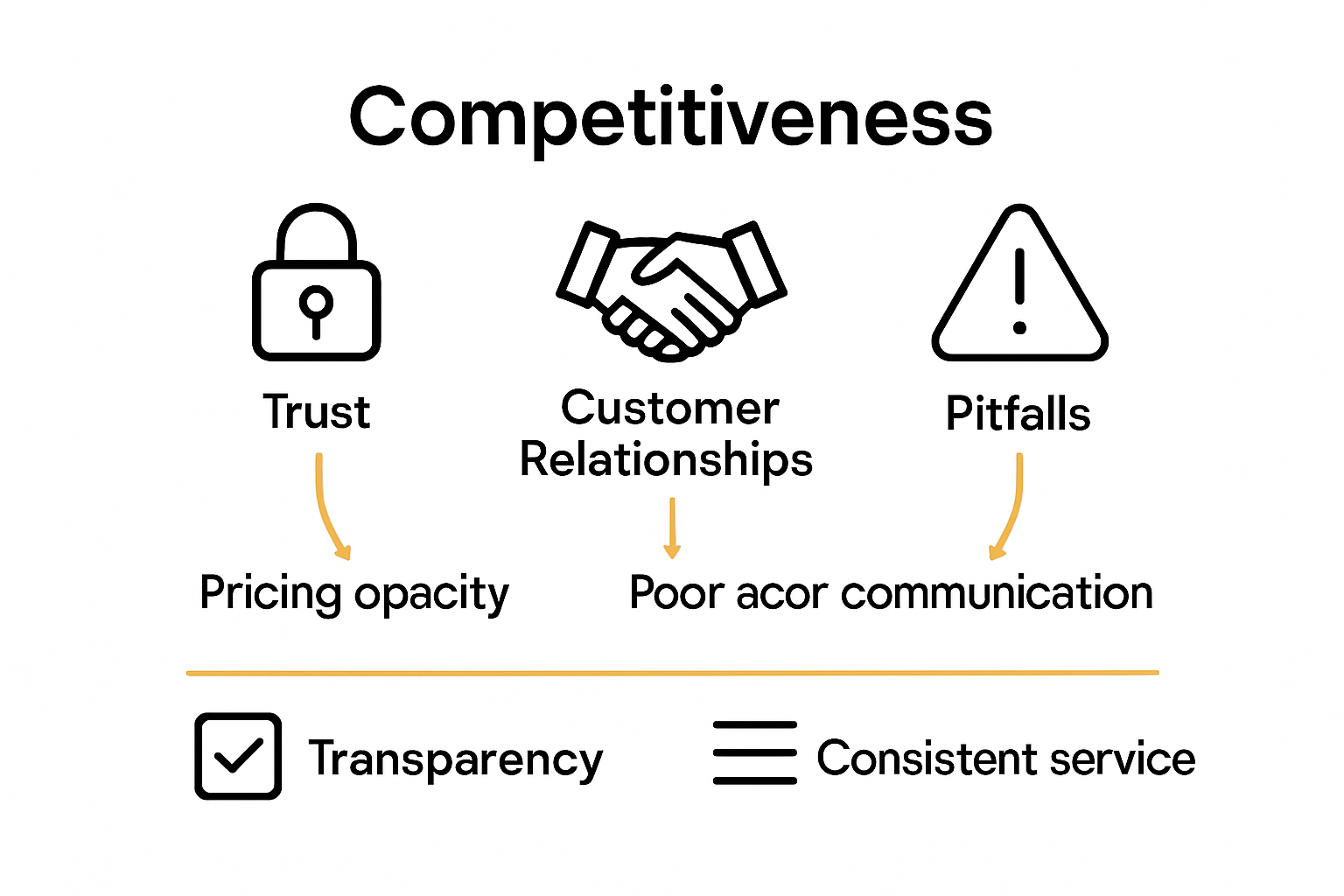
In the rapidly evolving world of ecommerce, seemingly minor strategic missteps can dramatically erode a company's competitive position. Research from arXiv reveals that implementing pricing strategies without transparency can critically damage customer trust and ultimately undermine a business's market reputation. These strategic pitfalls often emerge from short-sighted decision-making and a failure to understand the nuanced expectations of digital consumers.
Customer relationship management represents another critical area where businesses frequently compromise their competitive advantage. According to research from arXiv, neglecting relationship quality factors such as trust, satisfaction, and commitment can severely impact customer loyalty and long-term business sustainability. The most common mistakes that undermine competitiveness include:
- Opaque Pricing Strategies: Creating complex or hidden pricing structures
- Inconsistent Customer Experience: Failing to deliver uniform service quality
- Technological Inflexibility: Resisting digital transformation and innovation
- Inadequate Data Protection: Mishandling customer information and privacy
- Poor Communication Channels: Limiting customer interaction and support options
Successful ecommerce businesses recognize that maintaining competitiveness requires a holistic approach that prioritizes transparency, customer trust, and continuous adaptation. By proactively identifying and addressing potential strategic weaknesses, companies can develop more resilient business models that effectively respond to changing market dynamics and evolving customer expectations.
Elevate Your Ecommerce Competitive Advantage Today
Struggling to turn your ecommerce strengths into sustained market leadership Many ecommerce businesses face challenges such as inconsistent customer experience and technological inflexibility that can erode competitive advantage The article highlights crucial concepts like customer-centric design, technology innovation, and data-driven decision making as keys to building lasting differentiation and growth
Unlock your ecommerce potential with Tilly the all-in-one marketing app designed specifically for Shopify stores Seamlessly manage AI-generated email marketing, paid ads, social posts, video ads, and blog generation all from one powerful platform Take control of your customer engagement and automate personalized campaigns crafted to foster trust and loyalty Don't wait for competitors to outpace you Start building a smarter ecommerce strategy now by visiting Tilly and begin your journey towards scalable growth and unmatched market presence
Frequently Asked Questions
What is competitive advantage in ecommerce?
Competitive advantage in ecommerce refers to the strategic strengths and capabilities that allow an online business to outperform its competitors and provide exceptional value to customers.
How can an ecommerce business achieve cost leadership?
An ecommerce business can achieve cost leadership by optimizing operational efficiencies, reducing overhead costs, and offering lower-priced products than its competitors without compromising quality.
What role does technology play in building competitive advantage?
Technology plays a crucial role in building competitive advantage by enabling businesses to enhance customer engagement, streamline operations, and utilize data analytics for informed decision-making, thus improving overall efficiency and satisfaction.
What are common mistakes that can undermine competitiveness in ecommerce?
Common mistakes that undermine competitiveness in ecommerce include opaque pricing strategies, inconsistent customer experiences, technological inflexibility, inadequate data protection, and poor communication channels.
How do I gather competitive e commerce insights for my Shopify store?
You can gather competitive e commerce insights by analyzing competitor pricing, monitoring their product launches, studying customer reviews on rival storefronts, and tracking their social media engagement. Tools like SEO platforms, market research reports, and analytics dashboards help surface trends in real time. Combining these data points with your own store metrics gives you a clearer picture of where you can differentiate and outperform.